Friday, April 29, 2011

Endeavour's Final Flight and Asteroid Collisions


Despite some crazy storms rolling through the US south-east, the final flight of the space shuttle Endeavour is slated to go at 3:47pm EDT today. The above picture was taken during the night before the launch. While lightning and rocket fuel don't normally mix, NASA has lightning rods stationed all over the place to absorb the impacts and keep the shuttle safe.

Endeavour is carrying, among other payload, the AMS (Alpha Magnetic Spectrometer). This 7 ton instrument will be attached to the International Space Station and has a primary science mission of 3 years. The goal of the AMS is to detect and identify the types of cosmic rays in space. This is important because ground detectors of cosmic rays have a difficult time identifying the specific types of particle a cosmic ray is. It can generally say whether it was an electron, photon or atomic particle, and generally how massive it is. However it cannot identify which specific element it is, nor can it figure out if it is something more exotic like antimatter.

The AMS is basically a like taking a smaller version of one of the Large Hadron Collider particle detectors and flying it in space. So it has the capability to detect the type and energy of the particles that pass through it. Since it is so big it will also be able to probe high energies, which is extremely useful for cosmic ray physics and particle physics in general. The AMS will also provide a very accurate measure of what the radiation environment in space is like. This will be crucial for planning future manned space flights, especially interplanetary flights as precautions need to be taken to protect the astronauts from the dangerous radiation that permeates space.

You can join the other 750,000 people who will be watching the launch by watching it live on NASA TV. Any launch, particularly a shuttle launch is a sight to behold. Unfortunately I will be judging a science fair at the time so I can't watch.

Another interesting story came of NASA yesterday regarding a collision that happened between two asteroids. While the event itself was observed with a smaller telescope, both Swift and Hubble took a look at it shortly after the collision. The images show dust and debris being flung off of the impacted asteroid called Scheila. From the impact and comparing it to the Deep Impact event we know that the impactor was about 30 meters across and moving at about 11,000 mph. Scheila itself is about 70 km and lives in the Asteroid Belt between Mars and Jupiter. This is the first time this type of event has been observed so soon after the impact, excluding of course man made impacts. These type of impacts tell us a lot about the object that got hit as it excavates material from the asteroid that we would normally not see. Analyzing the debris can tell us about what the asteroid is made of. A link to the press release is below:

http://www.nasa.gov/topics/universe/features/asteroid-collision.html

Thursday, April 21, 2011

Review Article on Magnetic Fields in SNRs and PWNs

For those who are interested in such things there was a review article by Stephen Reynolds and friends on magnetic fields in SNRs and PWNs that will be appearing in Space Science Reviews. It was posted on astro-ph today:

http://arxiv.org/abs/1104.4047

Those not in the know may be wondering why we care about magnetic fields in these type of objects. Well knowing the magnetic field in supernova remnants (SNR) and pulsar wind nebulae (PWN) gives us handles on the effects of the magnetic field on the hydrodynamics of these objects and it gives us constraints on how particle acceleration is occuring. After all these objects boost particles up to 10-100's of TeV, and the magnetic field is thought to be the mediator of this acceleration. Thus understanding the field is fundamental in order to understand the impact of these objects.

Also there is a picture from a paper by our own Heather Matheson in the article. See if you can find it. Anyways thought people might be interested in reading such a review.

Monday, April 18, 2011

Wonders of the Universe Clip Package

Today's APOD is pretty impressive (as they usually are). It's a packaging together of a series of computer animations made by BDH for the BBC show "Wonders of the Universe". The combination of visual imagery and music is awesome. I always love these sort of animations as it helps us to visualize many astrophysical phenomena. Plus as an art piece it is quite amazing.

Unfortunately the animation is labelled or narrated so the viewer is left to figure out what is going on. The APOD description provides some of the content. However, since these animations were originally intended for "Wonders of the Universe", one should probably watch that to get the full context.

Nonetheless, I identified, in no particular order, the creation of a star via accretion. The Earth orbiting around the Sun up to the point where is goes Red Giant. A galaxy fly through. A supernova remnant with a pulsar at it's core. A supernova itself. A Low Mass X-ray Binary.

Can you do any better than me? Here is the link:

http://apod.nasa.gov/apod/ap110418.html

Wednesday, April 13, 2011

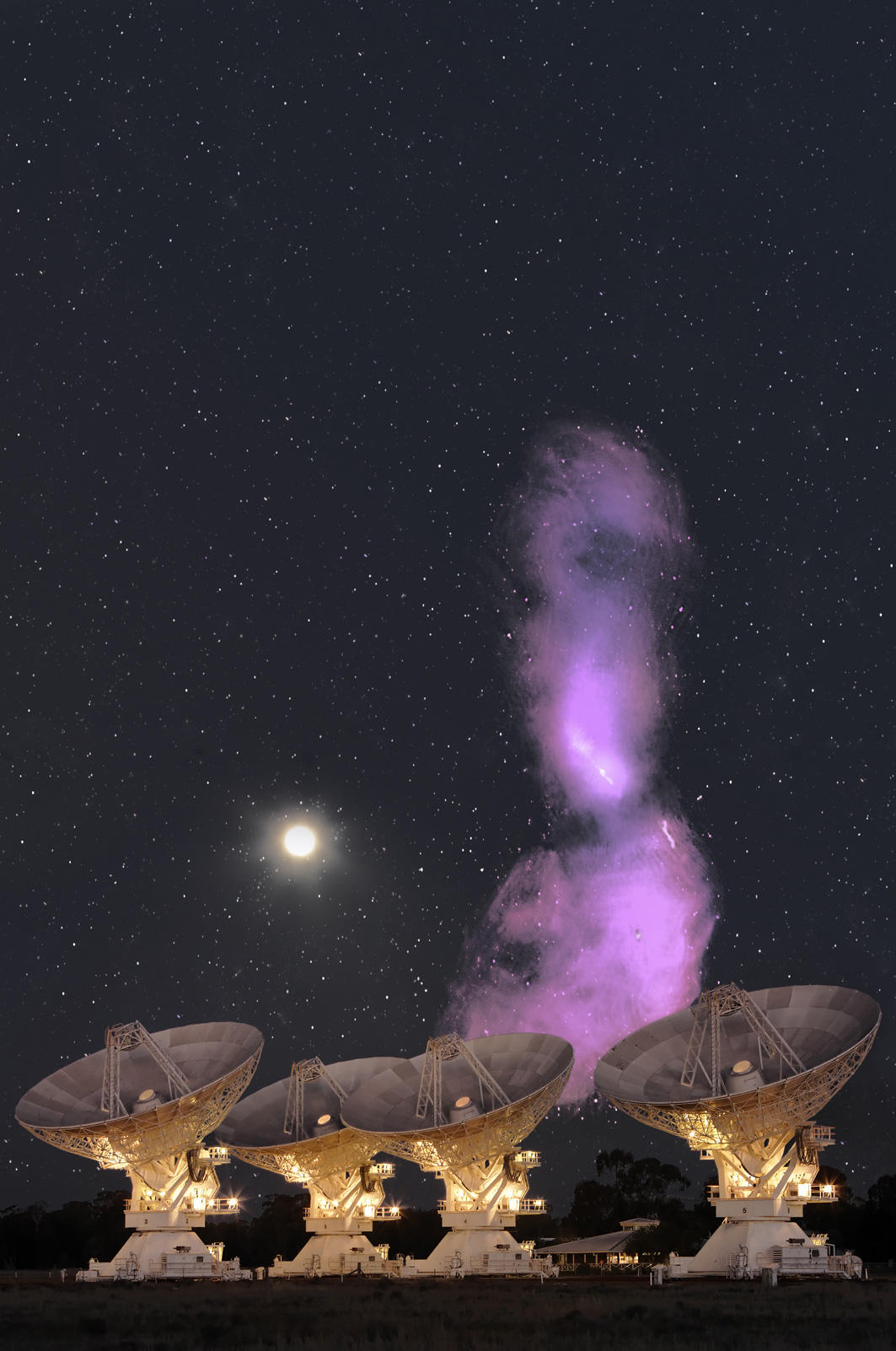
Centaurus A Compared to the Moon


Oh man, this picture of Centaurus A, Cen A for short, is astounding. This image is the subject of today's APOD. This is what one would see if the radio jets from Cen A could be seen in the optical. The foreground radio array is the Australian Telescope Compact Array (ATCA) which is one of the two telescopes that took the data for Cen A used in this picture, the other being the Parkes Radio Telescope. For those who are curious the paper on the data is here. In the background one can see the night sky with the Moon outshining all else. To the right of that is the actual size of the radio emission of Cen A on the sky. It's huge.

Even more staggering are the true size of Cen A's radio jets, which are 500 kiloparsecs in length. Truly gigantic. Cen A itself is the closest AGN (active galactic nucleus) to us at 3.8 Megaparsecs. That's right the radio jets of Cen A would stretch almost 1/8 of the way to Earth if they were pointed towards us.

Cen A is not the actual designation for this galaxy, but rather its radio designation. The name Cen A originates from this galaxy being the strongest radio emitter in the constellation of Centaurus. The actual galaxy it is associated with is NGC 5128 which is a massive elliptical galaxy that recently underwent a major merger. Most astronomers though call it Cen A because of the interest in its massive radio jets and because it is far easier to remember Cen A than its NGC designation.

So what's causing these huge jets? Well the current thinking is that the recent major merger caused gas to be fed into the central supermassive blackhole. Some of that gas gets caught up in the magnetic fields surrounding the blackhole and is ejected at relativistic velocities. The coupling of the rotation of the blackhole to the surrounding magnetic fields causes the ejected gas to be collimated into the jets we see. Since the jets carry a ton of kinetic energy they penetrate deep into space before being stopped by the ambient gas surrounding the galaxy.

The radio emission itself originates from synchrotron emission, which is also visible in the X-ray. Synchrotron results from relativistic charged particles, usually electrons, oscillating around a magnetic field. Since accelerating charged particles emit radiation, these particles emit radiation as the gyrate around the field. What frequency the emission comes out in depends on how fast the particle is going and how strong the magnetic field is. Since we see emission from radio all the way up to X-ray we know that Cen A is accelerating particles up to at least tens of TeV. Pretty crazy fast as I discussed in my post about RX J1713.

However there is a possibility that Cen A is accelerating particles, probably protons, up to even higher energies. Maybe even up to tens of EeV. This would mean that the particle in question would have as much energy as a major league fastball. This is a billion times higher energy than can be produced at the LHC. The Pierre Auger Observatory, which can detect these types of particles, has seen hints that indicate some of the particles that we see at this energy may be coming from Cen A. However this hasn't been confirmed yet.

For all of these reasons, and many more, Cen A has been and will continue to be a favorite target for Astronomers for years to come.

Tuesday, April 12, 2011

The Crab Nebula flaring again in gamma-rays!

Fermi LAT detection of a new enhanced gamma-ray emission from the Crab Nebula region. See the ATel here.

Yuri's Day

So I was a little early yesterday, but that article as too good to pass up. With it being the 50th anniversary of Yuri Gagarin's first trip around the world in space, I figure I will post a few more interesting articles that I found. First this one from NASA that contains archival footage of Yuri's flight:

http://www.nasa.gov/mission_pages/shuttle/sts1/gagarin_anniversary.html

It also happens to be the anniversary of STS-1. Next we have an article from Universe Today containing tons of cool pictures:

http://www.universetoday.com/84738/yuri-gagarin-and-vostok-1-photo-album-50th-anniversary-of-human-spaceflight/

Finally if you have some time to burn (about 1.5 hours) you can check out a compilation of images from the ISS recreating the first orbit that Yuri took. It is synced with audio from his first orbit as well. Even if you don't have time just fast forward through it and take a look at the stunning images:

http://www.youtube.com/user/firstorbit

Also check out Google's homepage art for today. Good stuff.

Sadly Yuri himself was taken from us far too soon. However his legacy will live on as humans journey further into the cosmos.

Monday, April 11, 2011

50 Years of Man in Space

Fifty years ago man first began his journey in to space. A momentous occasion to be sure. One filled with excitement and wonder.

The article below contains an excerpt from a book called "Moon Shot" which details the run up to the Moon Landing. The excerpt deals with Yuri Gagarin's very first flight into space. It's a great read. Definitely check it out:

http://www.msnbc.msn.com/id/42524606/ns/technology_and_science-space

Friday, April 1, 2011

April Fools on astro-ph

Ah, April Fools a day of great hilarity and pranks. In the world of astronomy it is now different. Take for instance this press release by Herschel:

http://herschel.cf.ac.uk/news/herschel-be-refilled-helium

However, some of the best and most subtle hoaxes can be found on arXiv, the pre-print server for most physical sciences. Every year there are several papers that appear on this day which are either clearly fake or are so well crafted that they appear real unless you read between the lines. All in good fun of course. Actually some of them end up getting cited in actual papers later on, usually as a joke by the authors doing the citing.

In order to save you from gleaning through the 40 odd papers that appeared today on astro-ph (the subsection of arXiv for Astronomy) I have taken time out of my busy day (actually I go through the articles every day anyways) to highlight the fake articles for this year. I will note that there might be some that show up late on next Monday, I will post those if I see them.

Our first article is titled "Non-standard morphological relic patterns in the cosmic microwave background" by Zuntz et.al (2011). This article searches the CMB for non-circular patterns in order to establish some very important information about the cosmos. The article can be found here:

http://arxiv.org/abs/1103.6262

Next we have "Photometry of a photometer" by Pal (2011). This article does photometry on the Herschel Space Observatory. This article is exceedingly important as it confirms the location and magnitude of the observatory. The article can be found here:

http://arxiv.org/abs/1103.6227

Third on our list is an ingenious paper titled "The Observed Inclination Problem: Solved at Last?" by Arzi (2011). This paper proposes a new system for investigating the 3-d nature of astronomical objects. The new system is so simple it is stupid, we could have saved billions by just following this suggestion. The paper is below:

http://arxiv.org/abs/1103.6167

Next is a paper titled "Searching for comets on the World Wide Web: The orbit of 17P/Holmes from the behavior of photographers" by Lang et.al. (2011). They use photos found via Yahoo Search (I'm surprised they didn't use Google :) ) of "Comet Holmes" to reconstruct the orbit of the comet. Note, they don't actually use the position of the comet in the photos but rather the direction that the camera is pointing.

In all honesty I'm not sure that this one is fake. I could actually see this being possible. I actually think they did the analysis, which is flat out ridiculous but possible. It's a very interesting and hilarious read regardless if it is fake or not. If this one is fake it definitely is convincingly real. The article is below:

http://arxiv.org/abs/1103.6038

Finally a brilliant piece about our place in the universe entitled, "On the Anthropic Principle in the Multiverse: Addressing Provability and Tautology" by Watson (2011). This paper is simply amazing. I actually think this one is the best one of them all. The paper can be found here:

http://arxiv.org/abs/1103.6044

Anyways, that is my round up of the fake papers on astro-ph today. A very good crop this year. I look forward to the ones generated for next year.