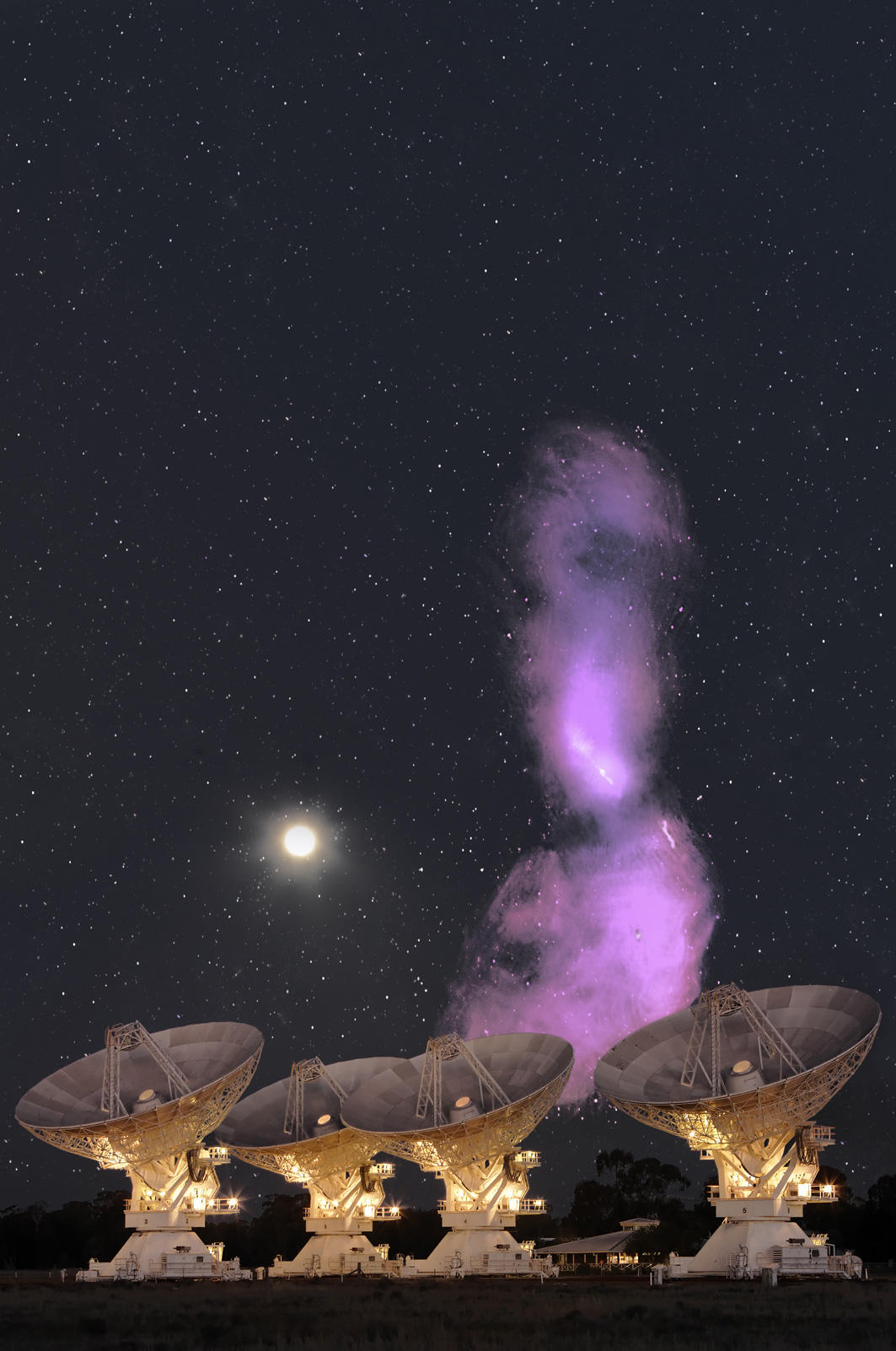
Oh man, this picture of Centaurus A, Cen A for short, is astounding. This image is the subject of today's APOD. This is what one would see if the radio jets from Cen A could be seen in the optical. The foreground radio array is the Australian Telescope Compact Array (ATCA) which is one of the two telescopes that took the data for Cen A used in this picture, the other being the Parkes Radio Telescope. For those who are curious the paper on the data is here. In the background one can see the night sky with the Moon outshining all else. To the right of that is the actual size of the radio emission of Cen A on the sky. It's huge.
Even more staggering are the true size of Cen A's radio jets, which are 500 kiloparsecs in length. Truly gigantic. Cen A itself is the closest AGN (active galactic nucleus) to us at 3.8 Megaparsecs. That's right the radio jets of Cen A would stretch almost 1/8 of the way to Earth if they were pointed towards us.
Cen A is not the actual designation for this galaxy, but rather its radio designation. The name Cen A originates from this galaxy being the strongest radio emitter in the constellation of Centaurus. The actual galaxy it is associated with is NGC 5128 which is a massive elliptical galaxy that recently underwent a major merger. Most astronomers though call it Cen A because of the interest in its massive radio jets and because it is far easier to remember Cen A than its NGC designation.
So what's causing these huge jets? Well the current thinking is that the recent major merger caused gas to be fed into the central supermassive blackhole. Some of that gas gets caught up in the magnetic fields surrounding the blackhole and is ejected at relativistic velocities. The coupling of the rotation of the blackhole to the surrounding magnetic fields causes the ejected gas to be collimated into the jets we see. Since the jets carry a ton of kinetic energy they penetrate deep into space before being stopped by the ambient gas surrounding the galaxy.
The radio emission itself originates from synchrotron emission, which is also visible in the X-ray. Synchrotron results from relativistic charged particles, usually electrons, oscillating around a magnetic field. Since accelerating charged particles emit radiation, these particles emit radiation as the gyrate around the field. What frequency the emission comes out in depends on how fast the particle is going and how strong the magnetic field is. Since we see emission from radio all the way up to X-ray we know that Cen A is accelerating particles up to at least tens of TeV. Pretty crazy fast as I discussed in my post about RX J1713.
However there is a possibility that Cen A is accelerating particles, probably protons, up to even higher energies. Maybe even up to tens of EeV. This would mean that the particle in question would have as much energy as a major league fastball. This is a billion times higher energy than can be produced at the LHC. The Pierre Auger Observatory, which can detect these types of particles, has seen hints that indicate some of the particles that we see at this energy may be coming from Cen A. However this hasn't been confirmed yet.
For all of these reasons, and many more, Cen A has been and will continue to be a favorite target for Astronomers for years to come.

1 comment:
Hiya Paul,
I sent congratulations to Ilana and Ron and let them know about this entry on the blog. (I accidently posted this on Yuri's day - I must talk to Maiko about my Firefox.)
cheers jayanne
Post a Comment